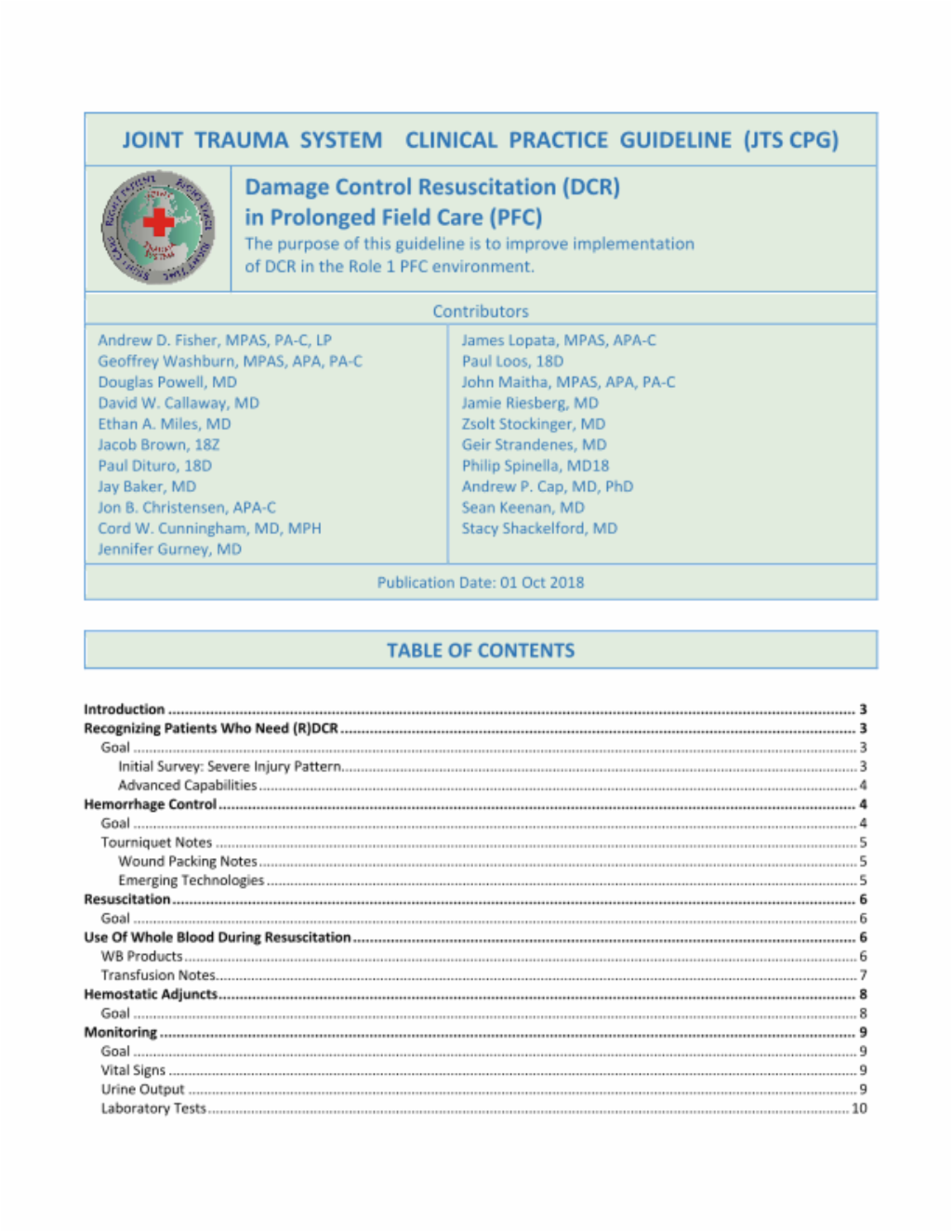
Damage Control Resuscitation in Prolonged Field Care
Joint Trauma System
INTRODUCTION
RAPID UPDATE, Jun 2023
- Calcium administration changed to 1 gram calcium
- Tranexamic acid (TXA) 2gm bolus is now favored over the traditional 1gm prehospital bolus followed by 1gm infusion over 8 hours. The 2gm TXA bolus should be given as close to the time of injury as possible and not outside of the 3 hours window.
Early recognition and intervention for life-threatening hemorrhage are essential for survival. The immediate priorities are to control life-threatening hemorrhage and maintain vital organ perfusion with rapid blood transfusion.1
Experience with fresh whole blood (FWB) resuscitation by military surgical teams deployed in US Central Command 2–4 led to a revolutionary change in resuscitation practices, termed damage control resuscitation (DCR).5 As DCR became the accepted standard in military and civilian trauma practice, the realization that the majority of potentially preventable battlefield deaths occurred prehospital and were attributed to hemorrhage6 launched a campaign to bring advanced resuscitation capabilities closer to the point of injury.7,8
Efforts to prevent death from hemorrhage begin with external hemorrhage control, followed by transfusion of whole blood (WB) or reconstituted WB with components in a 1:1:1 unit ratio when possible.9 DCR also limits the use of crystalloids to avoid dilutional coagulopathy and incorporates other adjunctive measures to mitigate hemorrhagic shock and acute traumatic coagulopathy, including:
- Early use of tranexamic acid (TXA)10
- Calcium repletion in patients at risk of hypocalcemia
- Prevention of acidosis and hypothermia
- Expeditious delivery to a damage control surgical capability
The purpose of this prolonged field care (PFC) guideline is to improve implementation of DCR in the Role 1 11 PFC environment by augmenting and consolidating the Tactical Combat Casualty Care (TCCC) and Joint Trauma System (JTS) guidelines for PFC situations. When patient evacuation is delayed or not available, evidence-based solutions may not be possible. In such cases, experience-based solutions may provide the best option in a compromised setting with limited resources. The CPG recommendations are presented in a "minimum, better, best" format that presents a hierarchy of approaches to address a spectrum of Role 1 situations and available resources. In all cases, this hierarchy builds on itself with “minimum” clinical standards still applicable in scenarios with the “best” available resources.
DCR principles practiced in the presurgical phase of resuscitation have been termed remote damage control resuscitation (RDCR).12 It is important to distinguish
RECOGNIZING PATIENTS WHO NEED (R)DCR
Goal
Recognize patients with traumatic hemorrhage who will benefit from implementing DCR early to decrease mortality.
Initial Survey:
Recognize hemorrhagic shock based on rapid examination and recognition of severe injury pattern.
- Injury pattern consistent with massive hemorrhage:
- Above-the-knee traumatic amputation, especially if associated with pelvic injury
- Proximal, bilateral, or multiple amputations (including mangled extremity)
- Clinically obvious penetrating injury to chest or abdomen
- Uncontrolled truncal or junctional bleeding
- Uncontrolled major bleeding secondary to large soft-tissue injuries
- Severe trauma with altered mental status (in the absence of brain injury) and/or weak or absent radial pulse.9
If initial survey does not indicate severe blood loss, continue assessment, check vital signs, and assess for signs of shock. Recognize hemorrhagic shock on the basis of presence of severe traumatic injury associated with the following:
- Systolic blood pressure (SBP) less than 100mmHg
- Pulse greater than 100 bpm
- Clinical signs of shock, such as cool extremities, delayed capillary refill
- Clinical signs of coagulopathy (e.g., thin, nonclotting bleeding from multiple sites, bleeding from minor wounds such as intravenous [IV] or intraosseous [IO] sites)
Advanced Capabilities
When additional laboratory capability and/or ultrasound are available, confirm evidence of hemorrhagic shock using laboratory and/or imaging studies. Do not delay initiating DCR if hemorrhagic shock is clinically suspected: Begin treating immediately once hemorrhagic shock is suspected.
Predictors associated with massive transfusion (i.e. more than 10 units of blood in the first 24 hours) may help identify patients who will require massive transfusion. The more predictors present, the higher the risk of massive transfusion.13–22
- Penetrating mechanism
- Positive focused assessment with sonography for trauma (FAST) examination (especially if two or more regions are positive)
- Lactate concentration greater than 4mmol/L on presentation
- Base deficit more than 6mEq/L (base excess less than −6mEq/L)
- pH less than 7.25
- International normalized ratio (INR) 1.5 or greater
HEMORRHAGE CONTROL
Goal
Stop external hemorrhage and reduce internal hemorrhage to the greatest extent possible. The first step in DCR is limiting blood loss by early and effective hemorrhage control. Interventions to control external hemorrhage are well described in the TCCC guidelines and should be applied as indicated.
- CoTCCC recommended limb tourniquets
- Wound packing
- Pressure dressings
- Hemostatic dressings (Combat Gauze, Celox Gauze, Chito Gauze, and XStat
- Junctional tourniquets
- Pelvic binders
Tourniquet notes9
- Tourniquets (limb and junctional) should be transitioned to pressure dressings within 2 hours when criteria for conversion are met (i.e. the casualty is not in shock, it is possible to monitor the wound closely for bleeding, and the tourniquets are not being used to control bleeding from an amputated extremity). Tourniquets that have been in place longer than 6 hours should not be removed unless close monitoring and laboratory capability are available.
- If the tactical situation or injury pattern does not allow for transition of a tourniquet to a pressure dressing, recognize that the priority is life over limb. At times, the decision to leave a tourniquet in place and commit the patient to an amputation is difficult. Consider telemedicine consultation.
- If a tourniquet has been applied for longer than 2 hours and the decision is made to reduce the tourniquet, resuscitation should address hyperkalemia and reperfusion syndrome, similar to crush injuries. See PFC Clinical Practice Guideline (CPG) Crush Syndrome under Prolonged Field Care.23
Wound Packing Notes
- If bleeding continues through the hemostatic dressing, reassess the wound. If the wound is fully packed and additional hemostatic dressings are available, consider removing the first dressing and packing a second dressing. If additional space exists in the wound cavity, augment the first dressing with a second hemostatic dressing or gauze dressing.
- The effectiveness of wound packing may be improved when skin closure over the packing can be achieved, either with suture, skin staples, iTClamp®, or application of a chest seal.
Emerging Technologies
Emerging technologies that may be considered for internal hemorrhage control
- Abdominal Aortic and Junctional Tourniquet (AAJT):
- This device, although not well studied, is the only noninvasive device available for aortic occlusion. Application of the AAJT (Compression Works; http:// compressionworks.com) may be considered for occlusion of the distal aorta when the injury pattern suggests bleeding in the pelvis and/or junctional lower extremities.
- If there is bleeding above the level of the umbilicus, in the upper abdomen or chest, application of the AAJT may increase bleeding.
- Ideally, ultrasound of the abdomen and chest should be performed to look for bleeding before AAJT application.
- Per manufacturer's guidelines, the AAJT should not be applied in the abdominal position for more than about 30 minutes.
- In the absence of evidence-based protocol, providers may consider: after 15–30 minutes of active resuscitation with blood products and attention to external hemorrhage control, the AAJT should be slowly released.
- If the systolic blood pressure drops below 90mmHg, reinflate the balloon and transfuse an additional unit of blood before releasing the balloon again. Look for other causes of hemodynamic instability.
- Continue to repeat as resources allow until blood pressure stabilizes or arrival at surgical capability.
- Resuscitative Endovascular Balloon Occlusion of the Aorta (REBOA): Only an advanced resuscitation team with the capabilities for massive transfusion, ultrasound, and arterial access would be expected to obtain the capability for REBOA placement. This device may be considered for occlusion of the aorta at either the position of the diaphragm (zone I, for abdominal hemorrhage or traumatic arrest) or the distal aorta above the aortic bifurcation (zone III, for pelvic and/or junctional lower extremity hemorrhage). Balloon time should be limited to 30 minutes for zone I. Maximum zone III inflation time is not known, but is likely in the range of 2–3 hours. See Joint Trauma System REBOA CPG.24 Aggressive blood product resuscitation and balloon deflation protocol must be followed, even without surgical intervention.
RESUSCITATION
Goal
Optimize fluid resuscitation to treat and reverse hemorrhagic shock effectively. Fluid resuscitation principles in PFC are the same as TCCC. Blood products are strongly preferred, and every effort should be made to ensure the capability to transfuse blood products is available near the point of injury. Survival is improved when blood products are transfused within about 30 minutes of injury.25
Resuscitation products of choice for casualties in hemorrhagic shock, listed from most to least preferred, are:
- Whole blood
- Plasma, red blood cells (RBCs), and platelets in a 1:1:1 ratio
- Plasma and RBCs in a 1:1 ratio
- Plasma or RBCs alone
- Crystalloid (lactated Ringer’s or Plasma-Lyte A).
Caution: Crystalloids or Hextend are therapies of last resort and can worsen coagulopathy and bleeding. They should be used only in severely bleeding patients with no radial pulse when no blood products are available. Every effort should be made through training and preparation to ensure availability of stored blood products and ability to draw FWB.
USE OF WHOLE BLOOD DURING RESUSCITATION
WB products
WB products listed from most to least preferred:
- Best: Low-titer group O whole blood (LTOWB) for all
- Food and Drug Administration–compliant LTOWB supplied by the Armed Services Blood Program.
- LTOWB drawn from prescreened donors at deployed location, either before mission or during combat casualty care.
- Identify LTOWB donors before deployment. Test all personnel with group O blood for anti-A and anti-B antibodies; low titer is defined as immunoglobulin M anti-A and anti-B ratio less than 1:256.
- Test for transfusion transmitted diseases (TTDs) before deployment and maintain a roster of donors while deployed. Repeat TTD testing every 90 to 120 days when possible.
- If adequate staff available, confirm ABO group of LTOWB donor prior to transfusing patient using Eldon card or other approved ABO testing kit. If the wrong blood group is transfused, there is a possibility of fatal transfusion reaction.
- Better: Administer group-specific WB from prescreened donors
- Group A to group A, group O to group O and LTOWB for group B and group AB.
- Group specific for all ABO Group
- The ABO group of the patient must be confirmed using Eldon card or other approved ABO testing kit. If the wrong blood group is transfused, there is a possibility of fatal transfusion reaction.
- Minimum: when prescreened donors for LTOWB or group-specific WB are not available, identify unscreened donors using an Eldon card or other approved ABO testing kit. If the need arises to use blood from unscreened donors. See Appendix B.
- Group specific (if adequate staff are available, perform testing and verify with second round of testing; i.e. two Eldon cards by two providers for both donor and recipient to be sure that groupings are correct; if the wrong blood group is transfused, there is a possibility of fatal transfusion reaction).
- If adequate staff or supplies not available or in chaotic situations, use group O for any patient (possibility of transfusion reaction if not titer tested; however, less likely to result in acute hemolytic transfusion reaction than mistaken group-specific transfusion).
Note: If blood-group testing has not been performed on the casualty before receiving LTOWB, it may not be possible to establish the underlying blood group and they should only receive universal donor blood products. Every effort should be made to obtain a blood sample for later typing before transfusion of LTOWB.
When WB cannot be obtained, resuscitation using blood products should proceed according to the order of priority for fluid administration, targeting an equal balance of all blood products that are available (RBCs, plasma, platelets).
Transfusion notes
- If time and staffing permit, utilize rapid TTD test kits when prescreened donors are not available. Priority for testing should be for HIV and/or any disease of high significance in local area for which test kits are available.
- During resuscitation, blood products and fluids should be warmed using a fluid warmer and infused rapidly.
- WB can be collected and transfused as warm, fresh whole blood (WFWB) or cold-stored whole blood (CS-WB). CS-WB will almost always be LTOWB. See WB CPG for more details.28
- WFWB may have some advantages for resuscitation in the PFC environment when prescreened donors are available and the tactical situation allows, because WFWB may be associated with improved survival in trauma patients.3,4,29 However, CS-WB is more completely tested for infectious disease and does not require additional personnel to collect or donate the blood, and should be used preferentially when available.
- Blood and blood products should only be administered by personnel who are trained in the proper procedure and the identification and management of transfusion reactions.
- Usually only one unit of FWB should be collected per donor. However, in extremis, two units may be taken from a single donor. Depending on the size and physical fitness of the donor, a two-unit collection may degrade the tactical performance of a donor, whereas a single unit collection will not. If a second unit is collected from the same donor, consider evacuating the donor with the casualty.
- Freeze-dried plasma (FDP) may be administered to initiate resuscitation while obtaining FWB and/or moving the casualty to a location where blood products are available. The indications to give FDP are the same as the indications for transfusion. FDP is a universal blood product that can be given to any blood group.
- See Appendix A for a summary of blood products provided by the Armed Services Blood Program.
HEMOSTATIC ADJUNCTS
Goal
Use medications to optimize the casualty’s ability to form blood clots.
TXA is an antifibrinolytic medication that helps to stabilize blood clots and may improve survival from hemorrhage. TXA should be administered for casualties with signs of hemorrhagic shock and all casualties who meet criteria for DCR within 3 hours of injury. TXA should not be given more than 3 hours after injury, because this has been associated with increased mortality.10,26,27
- Minimum: Administer TXA 2gm IV as soon as possible after injury (not more than 3 hours after injury).
Administration of undiluted TXA by slow IV push is acceptable if supplies or tactical situation prevent 100mL IV infusion. Ideally, slow IV push should be given over 10 minutes; however, it may be given faster when the tactical situation indicates, accepting the risk of transient hypotension. Use greater caution when the casualty is already hypotensive before TXA administration.
- Best: administer TXA as soon as possible (within 1 hour) after injury. Administer 2gm of TXA IV/IO ASAP, but NOT later than 3 hours
Calcium administration replaces serum calcium lost during hemorrhage and transfusion of citrated blood products. Calcium helps prevent cardiac dysfunction and hypotension.
- Minimum: Administer 1gm of calcium IV/IO during or immediately after transfusion of the first unit of blood product.
- Better: With ongoing resuscitation, give additional 1g of calcium after every four units of blood product.
- Best: Monitor serum calcium during ongoing resuscitation and administer 1g of calcium for ionized calcium less than 1.2mmol/L.
Caution: Calcium gluconate is safer for peripheral use. Calcium chloride may cause severe skin necrosis if extravasation occurs through a partially dislodged IV or IO catheter. The risk of bone necrosis with IO injection of calcium chloride is not known. When using peripheral IV or IO access, use extreme caution to ensure the device is in good intravascular position and no extravasation occurs.
Caution: Do not mix medications and blood products in the same IV line. Use a separate line or flush well between giving medications and blood products.
MONITORING
Goal
Maintain adequate oxygenation and ventilation, avoid hypotension, trend response to resuscitation.
Vital signs
Document vital signs frequently (every 15 minutes initially, then every 30–60 minutes once stable for more than 2 hours) on a flow sheet.30
- Minimum: Document signs and symptoms that could indicate hypovolemic shock and the response to resuscitation in order of early to late appearance in shock.
- Mental status
- Respiratory rate
- Heart rate
- Peripheral pulses
- Blood pressure
- Also document temperature and pulse oximetry
- Better: In addition to minimum requirements, monitor capnometry (displaying end-tidal CO2 (EtCO2) value, ideally with waveform).
- Best: Portable monitor providing continuous vital signs display; capnography
Urine output
Urine output (UO) is a valuable indicator of adequate resuscitation from hemorrhagic shock.
- Minimum: If patient can void, capture urine in premade or improvised graduated cylinder.
- Collect all spontaneously voided urine and carefully measure; more than 180mL every 6 hours is adequate for adults.
- A Nalgene® (Thermo Fisher Scientific, http://www.nalgene.com/) water bottle is an example of an improvised graduated cylinder.
- Best: Place Foley catheter and record UO hourly.
Laboratory tests
The utility of laboratory tests in the field setting should not be overlooked for simpler and readily available measurements, like UO. When a portable laboratory device is used, it may be useful to trend the following laboratory test values along with vital signs and UO to obtain a more exact clinical picture.
- Minimum: None
- Better: Check initial point-of-care lactate concentration.
- Best: Monitor one or more of the following laboratory values every 60 minutes until the patient is stabilized, then every 6 hours:
- Lactate
- pH and base deficit
- Hemoglobin/hematocrit
- INR
Note: Neurologic examination and vital signs trends are essential to identifying a deteriorating patient with traumatic brain injury (TBI). Monitoring EtCO2 is critical for patients with severe TBI. Ensure this capability is available.
ASSESSING RESPONSE TO RESUSCITATION
Overview
Assessing response to resuscitation is a dynamic process that is most accurate when all available data are used to paint a composite picture of the casualty. This whole picture is more accurate than any single normal (or abnormal) component.
Casualties will follow one of three trajectories in response to resuscitation: responder, transient responder, or nonresponder.
- Responder: Clinical and objective trends improve after resuscitation and remain stable.
- Transient responder: Trends improve after resuscitation, then decline. This decline should prompt reassessment of hemostatic procedures, assessment for missed hemorrhage, assessment of acidosis or hypothermia, and a trial of repeated resuscitation. If bleeding and factors that affect coagulopathy are controlled, transient responders will likely respond to more resuscitation. A subset of transient responders includes casualties with slow, noncompressible hemorrhage for whom resuscitation can “keep up” with blood loss until surgical hemostasis can be obtained, provided casualty has access to enough blood products and surgery can be obtained.
- Nonresponder: Trends do not improve or continue to worsen after initial trial of resuscitation. Before declaring a casualty to be a nonresponder, reassess hemostatic procedures, assess for missed sources of bleeding, and decompress both sides of the chest (needle decompression/finger thoracostomy/tube thoracostomy). Assess for pericardial tamponade by ultrasound or as a last resort, blind pericardiocentesis. If major bleeding cannot be controlled, it is not likely that the casualty will respond; this includes noncompressible torso hemorrhage where it is not possible for resuscitation to replace blood loss. If factors affecting coagulopathy (e.g., acidosis and hypothermia) cannot be corrected (with resuscitation and rewarming), it is also unlikely that the casualty will respond.
Note: If a casualty does not respond to resuscitation, a decision must be made whether to continue resuscitative efforts. If the casualty has worsened, further resuscitation is likely futile. If they have not responded but not worsened, a trial of additional resuscitation if resources are available can be considered to assess whether the initial resuscitation was insufficient.
Managing a nonresponding casualty is a complex decision that must balance availability of medical resources, demand of other casualties (or contingencies) for those resources, ability of the team to continue the effort of resuscitation, and other factors. It is highly advised to manage in consultation with medical experts (e.g., by telemedicine discussion).
END POINTS OF RESUSCITATION
Goal
Determine when to stop administration of blood products. It may be difficult to determine when to stop resuscitation and transition to maintenance monitoring and care. Patients may have abnormal vital signs for many reasons. Obtain teleconsultation if targets are not being met and/or trending in the wrong direction.
- Minimum: Identify clinical stabilization through ongoing monitoring and examination.
Slowing heart rate, palpable peripheral pulses, brisk capillary refill, warming extremities, improving mental status (if no brain injury), slowing/cessation of coagulopathic bleeding (wounds and/or IV site bleeding).
- Better: In addition to minimum, recognize improved vital signs and objective criteria.
- SBP at goal
- - Goal SBP is approximately 100mmHg if resuscitating with blood products (maintain mild hypotension until definitive bleeding control).
- - In patients with traumatic brain injury, goal SBP is greater than 110mmHg.
- - If unable to resuscitate with blood products, a lower blood pressure goal of SBP from 80– 90mmHg is acceptable.
- Oxygen saturation (Spo2) at least 90% (SpO2 >96% is not necessary),32 fraction of inspired oxygen (Fio2) required should be less than 50%
- Temperature greater than 95ºF (35ºC)
- UO greater than 30mL/h or greater than 0.5mL/kg/h o
- SBP at goal
- Best: In addition to minimum and better, confirm that hemorrhagic shock is resolving, using the following laboratory values:
- Hemoglobin concentration greater than 8.0g/dL
- Hematocrit greater than 27%
- Lactate concentration less than 2.5mmol/L
- Base deficit less than 4 (base excess greater than −4)
Note: Improving trends are as important as meeting absolute goals when assessing response.
If laboratory values do not improve or trend in the wrong direction for two or more different values, either additional resuscitation and/or hemorrhage control interventions are needed or the injury is not survivable given resources and capabilities available. Consider teleconsultation. Expectant management may be appropriate in some circumstances.
DOCUMENTATION SHOULD CONSIST OF THE FOLLOWING:30
Documentation should consist of the following:30
- Minimum: TCCC Card (DD1380)
- Better: PFC flowsheet
During prolonged care, once all available time blocks on the TCCC card are filled and evacuation to higher level of care is not imminent, transition to PFC flowsheet.
- Best: After action report in addition to above
Note: Blood products transfused, patient and donor identification must be reported to the COCOM Joint Blood Program Office (JBPO). Recipients of emergency collected whole blood must be enrolled into a follow-up infectious disease monitoring program (contact JBPO or ASBP for guidance).
PEDIATRIC CONSIDERATIONS
- Critically wounded or ill pediatric patients are more difficult for the Role 1 provider or medic because of the lack of regular exposure to pediatric care. It is recommended that a pediatric reference card or Broselow tape be available to identify pediatric ranges for vital signs, drugs, and supplies.
- Total circulating blood volume in children can be estimated at 70–80mL/kg for children younger than age 12 years.31 In very young or small children, this is a very small volume. For example, an average 1-year-old American child weighs 10–11kg and has a total blood volume approximately equivalent to two units of blood. Underestimating blood loss percentage and over resuscitating should both be avoided.
- As in adults, do not hesitate to use an IO catheter as the first and primary line for initial resuscitation. A second IV or IO line should be started as soon as possible for additional drug administration.
- TXA is indicated in pediatric casualties. The dose is 15mg/kg TXA loading dose (maximum, 1g) over 10 minutes followed by 2mg/kg/h for 8 hours (maximum, 1g).33
To prepare the second dose as a drip, inject 15mg/kg TXA into a 100mL bag of NS. Using a dial-a-flow drip set, place the drip rate at 13 mL/h (OR by drip count: 1 drip every 5 seconds for 60 drip/mL tubing; 1 drip every 18 seconds for 15 drip/mL tubing; 1 drip every 27 seconds for 10 drip/mL tubing).
- Similar to adults, early transfusion therapy should be started sooner rather than later. LTOWB and FWB are both acceptable to give to children with life-threatening hemorrhage. There is no contraindication to the use of any WB product in children. The initial dose for blood is 10mL/kg, but in children with massive hemorrhage, blood products can be given in higher doses as fast as needed to gain hemodynamic stability. Massive transfusion in pediatrics has been defined as more than 40mL/kg of blood products in 24 hours. WB is easier to titrate effectively in children than component therapy.
- Children are at high risk of developing hypocalcemia, hypomagnesaemia, metabolic acidosis, hypoglycemia, hypothermia, and hyperkalemia during transfusion. Therefore, frequent monitoring (every hour if possible) and correction of acid/base status, electrolytes, and core temperature is indicated during the resuscitation of pediatric casualties, when available.
END OF LIFE/EXPECTANT MANAGEMENT
Determining futility of care: despite best efforts, certain injuries are not survivable in austere environments. The tactical situation, casualty clinical condition, and operational constraints (e.g., mass casualty incidents, logistics) may warrant the consideration of ceasing ongoing, aggressive resuscitative efforts.
The provider must use all their operational knowledge to determine the utility of ongoing resuscitation. As a guide only, examples of wounds with low chance of survival include:
- Cranial injuries with exposed brain matter (exception may be isolated frontal lobe injuries) or severe TBI with signs of herniation (i.e. dilated pupils, hypertension plus bradycardia) or Glasgow Coma Scale score .3–5
- Penetrating thoracic or abdominal injuries that are hypotensive or nonresponsive after:
- two units blood transfusion
- bilateral chest decompression (needle decompression/finger thoracostomy/tube thoracostomy)
- assessment for pericardial tamponade
- Junctional amputations with pelvic disruption
- Out-of-hospital cardiac arrest (despite bilateral chest decompression), especially if surgical resuscitation is more than 10 minutes away.
- Blunt trauma mechanism without organized activity on cardiac monitor
- Cardiopulmonary resuscitation for longer than 5 minutes
- No cardiac motion observed on FAST examination or palpated with left finger thoracostomy
- Cardiac monitoring reveals:
- - Asystole
- - No organized rhythm
- - Wide complex/idioventricular rhythm
- Cervical spine trauma with cardiovascular collapse
- Obvious massive trauma, such as total body disruption and decapitation
- Nonresponders
Before cessation of resuscitation attempts by the provider, every attempt should be made to contact medical direction for input. If contact with higher medical direction is not feasible, then the on-scene provider must use their best judgment for ongoing resuscitation attempts. This may include an assessment of available resources, timing of evacuation, and the clinical condition of all the patients requiring the attention of the provider making the decision. It will not always be possible to save all team members.
A determination that further attempts to save a life are futile does not necessarily mean cessation of clinical care for the patient. All reasonable interventions to reduce pain and suffering, short of hastening death (e.g., not giving a lethal dose of opiates) should be provided. At times, agonal respirations and bodily movement can take place in the dying process; be prepared for this in the sight of comrades and be prepared to explain this. This is not a reason to continue resuscitative efforts.
If a casualty dies, all medical interventions should be left in place if feasible. If supplies may be needed for future casualties and resources are critically limited, it may be necessary to reuse medical devices (e.g., cricothyrotomy kits, chest tubes).
After death, a casualty should not be used as a blood donor for surviving casualties. Every attempt should be made to find alternate donors for any surviving casualties. Transfusing blood from a deceased casualty may result in transfusing acidotic and hypocoagulable blood, thus worsening the surviving casualty’s hemostatic physiology and possibly causing death.
Providers facing the dilemmas around patient death and cessation of resuscitative efforts should also be cognizant of the effects on team members, other patients, and on themselves. Various strategies for coping with these challenges may be appropriate in different circumstances. A full exploration of the topic is beyond the scope of this CPG; however, some consideration of these issues should be built into individual and unit training for PFC scenarios.
REFERENCES
- Gurney JM, Spinella PC. Blood transfusion management in the severely bleeding military patient. Curr Opin Anesthesiol. 2018;31: 207–214.
- Spinella PC, Perkins JG, Grathwohl KW, et al. Risks associated with fresh whole blood and red blood cell transfusions in a combat support Crit Care Med. 2007;35:2576–2581.
- Spinella PC, Perkins JG, Grathwohl KW, et al. Warm fresh whole blood is independently associated with improved survival for patients with combat-related traumatic injuries. J Trauma. 2009;66: S69–S76.
- Nessen SC, Eastridge BJ, Cronk D, et al. Fresh whole blood use by forward surgical teams in Afghanistan is associated with improved survival compared to component therapy without platelets. Transfusion. 2013;53:107S–113S.
- Holcomb JB, Jenkins D, Rhee P, et al. Damage control resuscitation: directly addressing the early coagulopathy of trauma. J Trauma. 2007;62:307–310.
- Eastridge BJ, Mabry RL, Seguin P, et al. Death on the battlefield (2001-2011): implications for the future of combat casualty care. J Trauma Acute Care Surg. 2012;73:S431–437.
- Malsby RF, Quesada J, Powel-Dunford, et al. Prehospital blood product transfusion by U.S. army MEDEVAC during combat operations in Afghanistan: a process improvement initiative. Mil Med. 2013;178:785–791.
- Fisher AD, Miles EA, Cap AP, et al. Tactical damage control resuscitation. Mil Med. 2015;180:869-875.
- Department of Defense Center for Excellence for Trauma. Joint Trauma System Tactical Combat Casualty Care Guidelines. 28 Aug 2017. http://jts.amedd.army.mil/index.cfm/committees/cotccc/guidelines
- CRASH-2 collaborators, Shakur H, Roberts I, et al. Effects of tranexamic acid on death, vascular occlusive events, and blood transfusion in trauma patients with significant haemorrhage (CRASH-2): a randomized, placebo-controlled trial. Lancet. 2010; 376:23–32.
- Joint Health Services. Joint Publication 4-02. 11 December 2017. http://www.jcs.mil/Portals/36/Documents/Doctrine/pubs/jp4_02.pdf
- Gerhardt RT, Strandenes G, Cap AP, et al. Remote damage control resuscitation and the Solstrand Conference: defining the need, the language, and a way forward. Transfusion. 2013;53: 9S–16S.
- Joint Trauma System Clinical Practice Guideline: Damage Control Resuscitation. 3 Feb 2017. https://jts.health.mil/index.cfm/PI_CPGs/cpgs Accessed Sep 2018.
- Schreiber MA, Perkins J, Kiraly L, et al. Early predictors of massive transfusion in combat casualties. J Am Coll Surg. 2007;205: 541–545.
- Nunez TC, Voskresensky IV, Dossett LA, et al. Early prediction of massive transfusion in trauma: simple as ABC (Assessment of Blood Consumption)? J 2009;66:346–352.
- Ogura T, Nakamura Y, Nakano M, et al. Predicting the need for massive transfusion in trauma patients: the Traumatic Bleeding Severity Score. J Trauma Acute Care Surg. 2014;76(5):1243–1250.
- Brown JB, Lerner BE, Sperry JL, et al. Prehospital lactate improves accuracy of prehospital criteria for designating trauma activation level. J Trauma Acute Care Surg. 2016;81(3):445–452.
- Brohi K, Cohen MJ, Ganter MT, et al. Acute coagulopathy of trauma: hypoperfusion induces systemic anticoagulation and hyperfibrinolysis. J Trauma. 2008;64(5):1211–1217.
- Lewis CT, Naumann DN, Crombie N, et al. Prehospital point- of-care lactate following trauma: a systematic review. J Trauma Acute Care Surg. 2016;81:748–755.
- Guyette F, Suffoletto B, Castillo J-L, et al. Prehospital serum lactate as a predictor of outcomes in trauma patients: a retrospective observational study. J Trauma. 2011;70:782–786.
- Callcut RA, Cotton BA, Muskat P, et al. Defining when to initiate massive transfusion (MT): a validation study of individual massive transfusion triggers in PROMMTT patients. J Trauma Acute Care Surg. 2013;74:59–67.
- Pidcoke HF, Aden JK, Mora AG, et al. Ten-year analysis of transfusion in Operation Iraqi Freedom and Operation Enduring Freedom: increased plasma and platelet use correlates with improved survival. J Trauma Acute Care Surg. 2012;73:S445–S452.
- Walters T, Powell D, Penny A, et al. Joint Trauma System Clinical Practice Guideline: Crush Syndrome under Prolonged Field Care (CPG ID: 58). 28 December 2016. http://jts.amedd.army.mil/assets/docs/cpgs/Prolonged_Field_Care_CPGs/Crush_Syndrome_Management_PFC_28_Dec_2016_ID39.pdf
- Joint Trauma System Clinical Practice Guideline: Resuscitative Endovascular Balloon Occlusion of the Aorta (REBOA) for Hemorrhagic Shock. 6 Jul 2017. https://jts.health.mil/index.cfm/PI_CPGs/cpgs Accessed Sep 2018
- Shackelford SA, del Junco D, Powell-Dunford N, et al. Association of prehospital blood product transfusion during medical evacuation of combat casualties in Afghanistan with acute and 30-day JAMA. 2017;318:1581–1591.
- CRASH-2 collaborators, Roberts I, Shakur H, et al. The importance of early treatment with tranexamic acid in bleeding trauma patients: an exploratory analysis of the CRASH-2 randomised controlled trial. 2011;377:1096–1101.
- Ausset S, Glassberg E, Nadler R, et al. Tranexamic acid as part of remote damage-control resuscitation in the prehospital setting: a critical appraisal of the medical literature and available alternatives. J Trauma Acute Care Surg. 2015;78:S70–S75.
- Joint Trauma System Clinical Practice Guideline: Whole blood transfusion 15 May 2018. https://jts.health.mil/index.cfm/PI_CPGs/cpgs Accessed Sep 2018.
- Perkins JG, Cap AP, Spinella PC, et al. Comparison of platelet transfusion as fresh whole blood versus apheresis platelets for massively transfused combat trauma patients. Transfusion. 2011; 51:242–252.
- Loos P, Glassman E, Doerr D, et al. Documentation in prolonged field care. J Spec Oper Med. 2018;18(1):126–132.
- Linderkamp O, Versmold HT, Riegel KP, et al. Estimation and prediction of blood volume in infants and children. Eur J Pediatr. 1977;125:227–234.
- Ginde AA. Strategy to Avoid Excessive Oxygen (SAVE-O2) in Critically Ill Trauma Patients: A Multicenter Cluster-Randomized, Stepped Wedge Trial for Targeted Normoxemia. Scientific Plenary Presentation (MHSRS-23-10446), Military Health System Research Symposium; August 14, 2023.
- Royal College of Paediatrics and Child Health. Evidence Statement. Major Trauma and the Use of Tranexamic Acid in Children. Nov 2012.
- Douhty H, Thompson P, Cap AP, et al. A proposed field emergency donor panel questionnaire and triage tool. Transfusion. 2016;56:S119–S127
APPENDIX A: BLOOD PRODUCTS AVAILABLE – ARMED SERVICES BLOOD PROGRAM

APPENDIX B: UNSCREENED DONOR PROCEDURES
When an emergency situation does not allow complete donor assessment according to the Joint Trauma System Whole Blood Transfusion Clinical Practice Guidelines,13 the following rapid donor screen may be used. Relaxing the donor acceptance criteria will increase the risk of transfusion-transmitted disease. The decision is a risk-benefit analysis.


APPENDIX C: WHOLE BLOOD DRAW AND STORAGE PLANNING GUIDE

APPENDIX D: DAMAGE CONTROL RESUSCITATION IN PROLONGED FIELD CARE: SUMMARY TABLE


APPENDIX E: ADDITIONAL INFORMATION REGARDING OFF-LABEL USES IN CPGS
PURPOSE
The purpose of this Appendix is to ensure an understanding of DoD policy and practice regarding inclusion in CPGs of “off-label” uses of U.S. Food and Drug Administration (FDA)–approved products. This applies to off-label uses with patients who are armed forces members.
BACKGROUND
Unapproved (i.e. “off-label”) uses of FDA-approved products are extremely common in American medicine and are usually not subject to any special regulations. However, under Federal law, in some circumstances, unapproved uses of approved drugs are subject to FDA regulations governing “investigational new drugs.” These circumstances include such uses as part of clinical trials, and in the military context, command required, unapproved uses. Some command requested unapproved uses may also be subject to special regulations.
ADDITIONAL INFORMATION REGARDING OFF-LABEL USES IN CPGS
The inclusion in CPGs of off-label uses is not a clinical trial, nor is it a command request or requirement. Further, it does not imply that the Military Health System requires that use by DoD health care practitioners or considers it to be the “standard of care.” Rather, the inclusion in CPGs of off-label uses is to inform the clinical judgment of the responsible health care practitioner by providing information regarding potential risks and benefits of treatment alternatives. The decision is for the clinical judgment of the responsible health care practitioner within the practitioner-patient relationship.
ADDITIONAL PROCEDURES
Balanced Discussion
Consistent with this purpose, CPG discussions of off-label uses specifically state that they are uses not approved by the FDA. Further, such discussions are balanced in the presentation of appropriate clinical study data, including any such data that suggest caution in the use of the product and specifically including any FDA-issued warnings.
Quality Assurance Monitoring
With respect to such off-label uses, DoD procedure is to maintain a regular system of quality assurance monitoring of outcomes and known potential adverse events. For this reason, the importance of accurate clinical records is underscored.
Information to Patients
Good clinical practice includes the provision of appropriate information to patients. Each CPG discussing an unusual off-label use will address the issue of information to patients. When practicable, consideration will be given to including in an appendix an appropriate information sheet for distribution to patients, whether before or after use of the product. Information to patients should address in plain language: a) that the use is not approved by the FDA; b) the reasons why a DoD health care practitioner would decide to use the product for this purpose; and c) the potential risks associated with such use.