Joint En Route Care Guidelines
JTS/CoERCCC
Joint En Route Care (ERC) Guidelines
The En Route Care (ERC) guidelines define the standards for providing medical treatment during casualty/patient movement from the point of injury/illness through successive roles of medical care and is a joint service responsibility in accordance with Joint Publication 4-02, Joint Health Services and DoD Instruction 6000.11, Patient Movement. ERC guideline responsibility resides with the Committee on En Route Combat Casualty Care (CoERCCC) under the Joint Trauma System’s Defense Committee on Trauma (DCoT). These guidelines align with the Committee on Tactical Combat Casualty Care (CoTCCC) framework, expanding casualty care into the ERC continuum and Prolonged Casualty Care (PCC).
ERC covers the transit medical care during:
- Medical Evacuation (MEDEVAC) – dedicated air and ground platforms with medically trained personnel to provide all levels of ERC.
- Casualty Evacuation (CASEVAC) – unregulated patient movement providing ERC aboard any vehicle/ platform not designated as MEDEVAC. Although CASEVAC can technically occur without trained medical personnel, the ERC guidelines are for trained medical personnel. This platform retains its legal combatant status and is not protected under the Geneva Conventions and Law of Armed Conflict.
- USAF Aeromedical Evacuation (USAF AE) – Strategic level patient movement between theaters of operation (intertheather) with all levels of ERC aboard fixed wing. Although the US Army is doctrinally responsibility for intratheater AE (covered under MEDEVAC), it can be conducted by the USAF as well.
- Multimodal Patient Movement (MM-PM) – MMPM is the regulated or unregulated movement of casualties using non-designated platforms of opportunity with medical personnel providing timely, efficient movement and ERC of the wounded, injured, or ill persons. Per DODI 11 this includes the combination of at least two mediums (air, rail, road, water) for patient movement.
Key Points
- Builds on Tactical Combat Casualty Care (TCCC) and Prolonged Casualty Care (PCC) principles utilizing the MARCH-PAWS framework (Massive Hemorrhage, Airway, respirations, Circulation, Hypothermia/Head Injuries, Pain Control, Antibiotics, Wounds, & Splinting).
- Reference the JTS Clinical Practice Guidelines (CPGs) for detailed clinical standards
- Emphasizes standardization, interoperability, and effective communication during patient hand-offs, essential to quality care and patient safety.
- Addresses a wide range of operational contexts, from rapid extractions to prolonged maritime or ground patient movements.
Operational Implications: ERC Guidelines are to inform and support but not replace local protocols
Future battlefields will demand ERC adaptable to variable evacuation platforms, times, contested environments, and diverse transport modes. These guidelines provide a scalable, evidence-informed framework to optimize outcomes regardless of environment, resource availability, or transport platform.
ERC guidelines unify joint force practices for casualty/patient movement and care, ensuring seamless integration from POI through the roles of medical care. By standardizing treatment expectations and reinforcing TCCC foundations, these guidelines strengthen the DoD’s ability to sustain survivability, confidence, and interoperability in current and future combat operations.

ERC Packaging and Movement
ERC Casualty Packaging Top 10
1. Optimize all interventions prior to transport à the en route care phases is one of the most challenging phases of care delivery and one of the most vulnerable for the patient. Do as much as possible to optimize the casualty’s condition prior to movement.
2. Prepare for movement:
a. Safely secure the patient -- use separate securing/retention straps and devices for the casualty and any equipment.
b. Personal Protective Equipment (PPE): all team members should have access to PPE, to include appropriate transport attire, life preserver (if applicable), helmet or cranial, and a securement device such as a monkey tail or gunners’ belt if transporting on an airframe.
3. Fully assess the patient prior to moving them to en route care platform:
a.Full assessment should be complete prior to movement, if unable, en route care provider will have to perform assessment.
b. Catalogue all injuries, this includes rolling the patient (using spinal and pelvic precautions depending on injuries). Assess airway, breathing (auscultate lung fields and palpate the chest for expansion) and ensure no missed external bleeding. Wounds and any dressings should be labeled if possible. Tourniquets (TQ) should be assessed and ensure TQ times are documented.
c. If an advanced airway is in place, assess lung compliance via programmed versus delivered tidal volume and peak inspiratory pressure.
d. Establishing a solid baseline assessment with your team using the MARCH-PAWS approach is essential for communication along the continuum of care.
- Use MARCH-PAWS for patient reassessments and as a problem-solving battle rhythm for your team during ongoing care or to mitigate patient decompensation while en route.
4. Prepare medications, secure interventions, and package casualties as needed for the environment.
a. If there are logistical concerns, be cautious about wasting medication or supplies.
5. Calculate en route O2 requirements to ensure adequate supply during transport
a. Include altitude considerations
b. Target SpO2 levels between 92 - 96%.
c. Account for resource management in mass casualty events, large scale combat operations, distributed maritime operations, and delayed evacuation.
d. (Tier 3 & 4) See Appendix A for Oxygen Tank Conversion Factors and Oxygen Requirement Calculation.
6. Intravenous (IV) line management:
a. Label where IVs are placed on the outside of HPMK/blanket/warming device with tape or maker
b. Ensure all IVs are well secured with no tension present
c. Dedicate an IV line for medication administration only
d. Separate, mark, and place the administration port that is accessible to all en route team members
7. Prevent hypothermia!
a. Position the casualty so they are protected from the elements
b. Monitoring the casualty’s core temperature
c. Use fluid warmers
8. TQ management:
a. Reassess the need for TQ prior to prolonged movement
b. TQ conversion is ideally performed prior to en route care
c. Placing a loose proximal extremity tourniquet 2-3 inches above wounds that initially had a TQ placed and was then transitioned to a pressure dressing – ensure loose and not occluding venous outflow. This is to facilitate rapid hemostasis in the event of re-bleed during challenging movement (g., bumpy roads, catapult launch from a carrier, or high sea states).
9. Enable easy communication:
a. Ensure your ERC team can reliably communicate while en route
b. Have an internal communication system or written system (i.e. notes, whiteboard, iPad)
10. Postoperative considerations are covered in Appendix B.
DETAILED CASUALTY MOVEMENT PLANNING CONSIDERATIONS
GENERAL
Regardless of mode of transport during the ERC, make sure all equipment is adequately secured to the casualty or vehicle/aircraft/boat so they do not become missile hazards.
• ERC, especially by aircraft, is a dynamic and noisy environment.
• A continuous reassessment of casualties is essential to quality patient care. The patient's condition, including mental status, and vital signs should be evaluated every 5-15 minutes.
• All critical interventions, including tourniquets, airway devices, ventilators, and infusions should be checked for effectiveness and security throughout transport.
• Consider the ambient temperature when administering blood products (e.g. blood left in the sun may break down RBCs).
• Secure all interventions (tape for lines, wraps for dressings, etc.).
• Flag invasive lines with tape to feel for line movement in poor visibility conditions.
• Consider measures for comfort and pressure injury prevention for all patients such as padding the litter or utilizing headrests.
• Utilize pressure infusers as needed to maintain flow of blood or fluid (ensure all air is out of bag prior to infusion)
• Utilize equipment/litter mounting options (SMEED, COTs, etc.) as needed and if available.
• Major procedures (such as securing an airway, prophylactic escharotomies, central line or foley catheter placement, etc.) should be performed prior to movement if the tactical situation allows. Space constraints and transport vehicle motion may make it difficult to perform major procedures or interventions during transport.
FOOT TRANSPORT
• Familiarize your team with the foot transport method and litter/sled type.
• Do not place additional supplies or equipment directly on top of the casualty.
• Consider and plan work rest cycles
GROUND TRANSPORT
• Determine how the casualty will be secured in/on the vehicle prior to loading.
• Position the casualty in the vehicle so the most critically injured locations can be easily accessed and re-assessed.
• If both sides of the casualty cannot be accessed during transport, the side with higher risk injuries (large wounds, hemothorax, etc.) should be closer to the provider.
AIR TRANSPORT
• Cover all interventions and secure all lines prior to loading the aircraft as rotor wash may dislodge lines and equipment.
• Position the casualty in the aircraft so the most critically injured locations can be easily accessed and re-assessed.
• Specialized stanchions or mounting systems may be required to secure the casualty litter in the aircraft.
• Ratchet/tie-down straps may be used to secure the litter to the floor/deck.
• Hypothermia and hypoxia are significant risks during flight that may affect casualty outcomes. Communicate temperature and altitude (or cabin altitude) needs with the flight crew.
• Movement via catapult from an aircraft carrier can be violent, often causing re-bleeding or shifting of interventions. Place loose tourniquets on limbs at risk for rebleeding. Reassess all interventions. Discuss patient position with air crew prior to catapult launch.
• Reassess any interventions utilizing pneumatic (air) pressure (e.g. endotracheal tube cuffs) at altitude and on descent.
• Patients need hearing protection.
• Consider how you will communicate with your patient if able. Consider non-traditional means such as whiteboards.
MARITIME TRANSPORT
• Cover dressings and wounds with water resistant materials.
• Keep casualty raised above the deck to avoid pooled water.
• Ratchet/tie-down straps may be used to secure the litter to the deck.
HAND-OFF
At each phase of casualty “Hand-Off”, complete the following:
- Repeat the MIST Report
- Perform verbal turnover with receiving team
- Provide/hand off all documentation to receiving team
- Prioritize relay of “invisible interventions” such as medications administered
- Walk through and visualize all interventions performed
- Replace all consumables
- Retain and clean all durable transport equipment (monitors, ventilators, O2 tanks, etc.)
- Establish means for continued comms should questions arise
Specific sections may also identify additional “HAND-OFF” considerations, examples below:
- Relay all medications administered
- Verify all TQs are secure and functioning with the receiving team (Massive Hemorrhage)
- Verify airway placement via auscultation and EtCO2 with the receiving team (Airway)
- Ensure any used blood product/component bags are left with the receiving team (Circulation)
Communication and Documentation
Pre-Deployment, Mission Planning, and Training Considerations:
Communication and documentation in ERC are dual priorities. Since verbal turnover at the receiving facility may be short, thorough documentation of care rendered is vital for patient safety and continuity of care.
Communication
- Communicate with the casualty if possible. Encourage, reassure and explain care.
- Communication with the crew and casualty may be difficult depending on the mode of travel. If traveling by air, extra helmets with an Internal Communication System (ICS) may not be available, so the transport provider may need to use other ways to communicate, such as a notepad or whiteboard.
- Communicate with tactical leadership as soon as possible and throughout casualty treatment as needed. Provide leadership with casualty status and evacuation requirements to assist with coordination of evacuation assets.
- Verify evacuation requests have been transmitted and establish communication with the evacuation platform as soon as tactically feasible.
- Patient Hand-Off: Have a rehearsed script to relay vital information to the next echelon of care; prioritize interventions that cannot be seen by the next provider (e.g. medications).
- Use the MIST (Mechanism of injury, Injuries sustained, Signs and symptoms, and Treatments rendered) report to pass on pertinent information along with completed documentation.
TCCC ASM (Tier 1) and CLS (Tier 2) Documentation
Complete Basic TCCC Communication and Documentation Principles, then:
- Identify requirements for communicating care to the casualty, leadership, and medical personnel in accordance with (IAW) CoTCCC Guidelines.
- Document casualty information on the DA Form 4700/DD3104, or if not available, the DD Form 1380 TCCC card. Ensure proper placement of that card on the casualty IAW DHA-PI 6040.01, Implementation Guidance for the Utilization of DD Form 1380, Tactical Combat Casualty Care (TCCC) Card.
TCCC CMC (Tier 3) and CPP (Tier 4) Documentation
Ensure Documentation and Communication is Completed for each Casualty IAW ERC Standards:
- Ensure that communication is established with evacuation assets and/or receiving facilities
- Prepare evacuation requests and set up priorities for evacuation for each casualty
- Ensure DA Form 4700/DD3104, DD1380 TCCC Card, USAF Form 3899 (or unit specific form) are completed for every casualty transported.
Completed Forms need to be submitted to email link listed below
(NIPR/SIPR provided depending on classification)
JTS NIPR: dha.jbsa.healthcare-ops.list.jts-patientevacuation@health.mil
JTS SIPR: usarmy.jbsa.medcom.mbx.joint-trauma-system-operations-mailbox@mail.smil.mil
Massive Hemorrhage


Airway


Respiration and Ventilation


Circulation and Resuscitation (including Crush Injuries)


Hypothermia

Head Injury


Pain Management (Analgesia and Sedation)


Antibiotics and Other Medications


Wounds

Burns


Splints

Appendix A: Oxygen Conversion Factors and Oxygen Requirement Calculation

Appendix B: Post-Operative Considerations
HEAD/FACE
Surgical procedures in this anatomic region include craniotomy, lateral canthotomy, mandibular/maxillary fracture stabilization, and hemorrhage control measures.
- If drain is in place, consult with neurosurgeon for CSF drainage and pressure goals. (If unable to locate neurosurgeon, can drain 5-10 mL for sustained ICPs > 20 mmHg, no more than 30 mL/hr, with pop-off set to 20 mmHg).
- If intracranial device becomes dislodged during transport, do not attempt to reinsert. Place sterile dressing over surgical site.
- Alert patients with facial fractures who are protecting their own airway should be transported in a position of comfort.
DEVICES
External Ventricular Drain: Leveled at the tragus of the ear. Drainage per provider order.
NECK/TORSO
- Surgical procedures in this anatomic region include airway management, temporary repair of organs and great vessels and placement of drains into the thorax or abdomen. Special care must be taken during casualty movement to not disrupt these interventions.
- Hemorrhage in this region is generally NOT amenable to tourniquet or direct pressure. Early recognition of re-bleeding is paramount.
- Signs of ongoing hemorrhage: Tachycardia, hypotension, increased blood in collection devices (chest tubes, foley, wound vacs), increased abdominal girth, or increased pulmonary/ abdominal pressures. Resuscitate with blood product, targeting MAP of 65 mmHg. Discuss actions to take with surgical team prior to transport, advanced providers may be able to perform abdominal packing in a crashing casualty. Circumferential dressings should be evaluated to ensure chest expansion is not restricted.
- Thoracotomy sites shall be inspected after all casualty movements. If the chest tube has become dislodged, do not advance into the chest cavity.
- Reassess at appropriate intervals. Clamp and drain chest tube intermittently; if clamped, closely monitor for recurrent tension pneumothorax. If available, use low continuous suction. Ensure a one-way valve is attached and working. One-way valves are required for all flight transports.
- Any casualty with a surgical procedure requires Ertapenem if they have not already received it
DEVICES
Airway: The back-up airway for accidental removal of established definitive airway should be discussed and decided prior to movement depending on skill level of the provider. The minimum airway skills required for transport of an intubated casualty are BVM with PEEP, supraglottic airway, and cricothyroidotomy. Cricothyrotomy and tracheostomy tubes should be secured prior to transport. Sutures are preferred, but commercial securing device, or other methods such as chest seal may be acceptable).
Thoracostomy tube (Chest tube): All fenestrations (drainage holes) should be within the chest cavity. Tube should be secured with sutures and covered with occlusive dressing. Chest tube should have a one-way valve in place between tube and collection device. Collection device should be placed below the level of insertion if possible and placed to suction (if available) per provider order (generally -15-20 cmH2O). If collection device is damaged, maintain drainage below the level of insertion and use suction canister or other improvised device to collect drainage. DO NOT CONNECT DIRECTLY TO SUCTION. If chest tube is dislodged, cover insertion site with occlusive drainage (three sided or drainage capable). Monitor for pneumo/hemothorax and treat per provider level (Needle decompression / Finger thoracostomy / Chest tube).
Arterial Line / CVP Transducer: Leveled at phlebostatic axis. Zero/re-zero as needed.
Bladder Pressure Monitoring: Pressure monitoring connected to foley catheter. Pressure > 20 mmHg with concerning abdominal exam considered surgical emergency.
Wound vac: All drainage holes should be within cavity/compartment and covered with occlusive dressing. If emptying of collection device is required during transport, document time and amount removed and reset vacuum seal. If collection device is damaged, cover with biohazard bag or other improvised method. If device is dislodged/removed, do not attempt to replace. Cover insertion site with occlusive dressing.
EXTREMITIES
Hemorrhage is the most likely postoperative complication in this region. Bleeding accompanied by any hemodynamic change should initially be controlled by tourniquet application.
Prior to transport, place a loose tourniquet high on the injured extremity. This will expedite hemorrhage control when recognized. Minimal bleeding from a surgical site without hemodynamic changes may be controlled with direct pressure and hemostatic agents.
DEVICES
Wound vac: All drainage holes should be within cavity/compartment and covered with occlusive dressing. If emptying of collection device is required during transport, document time and amount removed and reset vacuum seal. If collection device is damaged, cover with biohazard bag or other improvised method. If device is dislodged/removed, do not attempt to replace. Cover insertion site with occlusive dressing.
External Fixator: Minimal bleeding is expected around pin insertion. Pad around device to avoid transmitting vehicle vibration to the casualty. Check for evidence of infection.
Casting/Dressing: Circumferential rigid casts should be avoided initially. Pulse, motor, and sensory checks should be performed routinely. If any are diminished, cast/dressings must be loosened (bivalve) or removed.
Pelvic binders and/or Junctional Hemorrhage devices shall be routinely checked for proper placement and security, especially after casualty transfers. In flight, inflating hemorrhage control devices could increase, or decrease based on pressure and should be checked often.
Femur traction splints need to be stabilized and secured during transport. Movement and vibrations can cause traction to slip, potentially causing harm. Frequently reassess pulses of the extremity. If pulses diminish, check the splint to ensure limb is out to length and ensure dressing is not having a tourniquet effect.
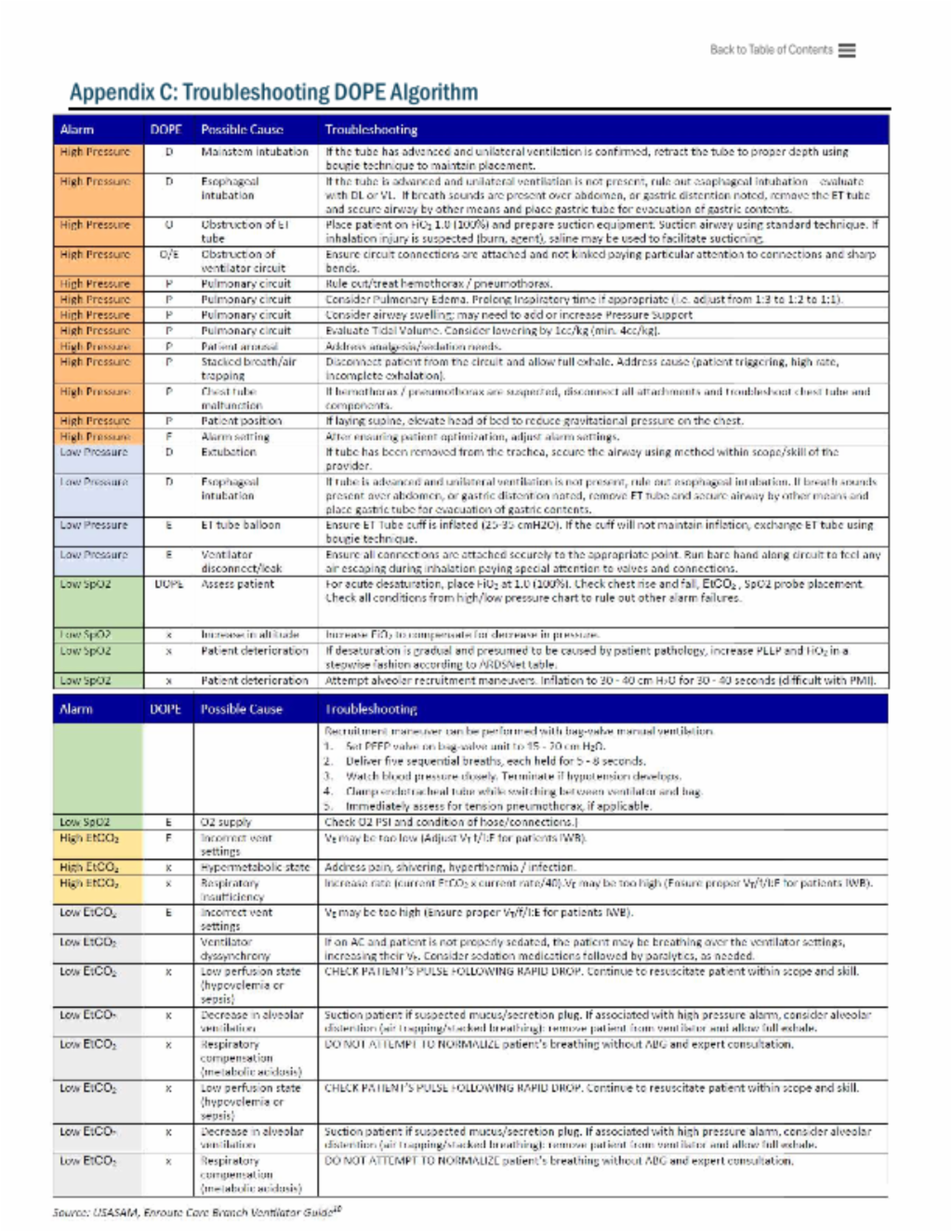
Appendix D: Airway Assessments Acronyms

Appendix E: Difficult Intubation Assessment (3-3-2)


Appendix G: Hypocapnia and Hypercapnia Causes

Appendix K: Rule of 9’s

Appendix L: Rule of 10’s Quick Reference Chart

Appendix M: Escharotomy Reference

References
- TCCC Guidelines, 15 Dec 2021. https://deployedmedicine.com/market/31/content/40
- Kotwal RS, Howard JT, Orman JA, Tarpey BW, Bailey JA, Champion HR, Mabry RL, Holcomb JB, Gross KR. The effect of a Golden Hour Policy on the morbidity and mortality of combat casualties. JAMA Surg. 2016 Jan;151(1):15-24. https://jamanetwork.com/journals/jamasurgery/fullarticle/2446845 Accessed Nov 2021
- Kuckelman, J., Derickson, M., Long, W.B. et al. MASCAL Management from Baghdad to Boston: Top Ten Lessons Learned from Modern Military and Civilian MASCAL Events. Curr Trauma Rep 4, 138–148 (2018). https://doi.org/10.1007/s40719-018-0128-0
- Gurney JM, Spinella PC. Blood transfusion management in the severely bleeding military patient. Curr Opin Anesthesiol. 2018;31: 207–214. https://journals.lww.com/co-anesthesiology/Fulltext/2018/04000/Blood_transfusion_management_in_the_severely.15.aspx Accessed Nov 2021.
- JTS, Damage Control Resuscitation (DCR) in Prolonged Field Care, 01 Oct 2018 CPG. https://jts.amedd.army.mil/assets/docs/cpgs/Damage_Control_Resuscitation_PFC_01_Oct_2018_ID73.pdf
- Eastridge BJ, Mabry RL, Sequin P, et al. Death on the battlefield (2001-2011): implications for the future of combat casualty care. J Trauma Acute Care Surg. 2012;73(6 Suppl 5):S431-7. https://www.east.org/content/documents/MilitaryResources/b/TCCC%20Eastridge%20Death%20on%20the%20Battlefield%20J%20Trauma%202012.pdf Accessed Nov 2021.
- Hudson I, Blackburn MB, Mann-Salinas EA, et al. Analysis of casualties that underwent airway management before reaching Role 2 facilities in the Afghanistan conflict 2008-2014. Mil Med. 2020;185(Suppl 1):10-18. https://pubmed.ncbi.nlm.nih.gov/32074383/
- Blackburn MB, April MD, Brown DJ, et al. Prehospital airway procedures performed in trauma patients by ground forces in Afghanistan. J Trauma Acute Care Surg 2018;85(1S Suppl 2):S154-S160. https://journals.lww.com/jtrauma/Fulltext/2018/07002/Prehospital_airway_procedures_performed_in_trauma.23.aspx Accessed Nov 2021.
- JTS, Airway Management in Prolonged Field Care, 01 May 2020 CPG https://jts.health.mil/index.cfm/PI_CPGs/cpgs
- JTS, Documentation in Prolonged Field Care, 13 Nov 2018 CPG https://jts.health.mil/index.cfm/PI_CPGs/cpgs
- JTS, Documentation Requirements for Combat Casualty Care, 18 Sep 2020 CPG https://jts.health.mil/index.cfm/PI_CPGs/cpgs
- JTS, Hypothermia Prevention, Monitoring, and Management, 18 Sep 2012 CPG https://jts.health.mil/index.cfm/PI_CPGs/cpgs
- Marr AL, Coronado VG, eds. Central Nervous System Injury Surveillance. Data Submission Standards-2002. Atlanta, GA: Centers for Disease Control and Prevention; 2004. http://citeseerx.ist.psu.edu/viewdoc/download?doi=10.1.1.194.2694&rep=rep1&type=pdf. Accessed Nov 2021
- JTS, Traumatic Brain Injury Management in Prolonged Field Care, 06 Dec 2017 CPG https://jts.health.mil/index.cfm/PI_CPGs/cpgs
- JTS, Analgesia and Sedation Management During Prolonged Field Care, 11 May 2017 CPG https://jts.health.mil/index.cfm/PI_CPGs/cpgs
- JTS, Pain, Anxiety and Delirium, 26 Apr 2021 CPG https://jts.health.mil/index.cfm/PI_CPGs/cpgs
- Keep JW, Messmer AS, Sladden R et al. National Early Warning Score at Emergency Department triage may allow earlier identification of patients with severe sepsis and septic shock: a retrospective observational study. Emerg Med J 2016;33:37–41. https://emj.bmj.com/content/33/1/37 Accessed 01 Dec 2021.
- JTS, Infection Prevention in Combat-Related Injuries, 27 Jan 2021 CPG https://jts.health.mil/index.cfm/PI_CPGs/cpgs
- JTS, Sepsis Management in Prolonged Field Care, 28 Oct 2020 CPG https://jts.health.mil/index.cfm/PI_CPGs/cpgs
- JTS, Nursing Intervention in Prolonged Field Care, 22 Jul 2018 CPG https://jts.health.mil/index.cfm/PI_CPGs/cpgs
- JTS, Acute Traumatic Wound Management in the Prolonged Field Care Setting, 24 Jul 2017 CPG https://jts.health.mil/index.cfm/PI_CPGs/cpgs
- JTS Orthopaedic Trauma: Extremity Fractures CPG, 26 Feb 2020 https://jts.health.mil/index.cfm/PI_CPGs/cpgs
- JTS, Burn Wound Management in Prolonged Field Care, 13 Jan 2017 CPG https://jts.health.mil/index.cfm/PI_CPGs/cpgs
- Walrath, B. Searching for systems-based solutions to enhance readiness. Navy Medicine Live online blog.
- Faiver L, Hensler D, Rush SC, Kashlan O, Williamson CA, Rajajee V. Safety and Efficacy of 23.4% Sodium Chloride Administered via Peripheral Venous Access for the Treatment of Cerebral Herniation and Intracranial Pressure Elevation. Neurocrit Care. 2021 Dec;35(3):845-852. doi: 10.1007/s12028-021-01248-7. Epub 2021 Jun 25. PMID: 34173156.
- Weichel ED, Colyer MH. Combat ocular trauma and systemic injury. Curr Opin Ophthalmol. 2008 Nov;19(6):519-25. doi: 10.1097/ICU.0b013e3283140e98. PMID: 18854697.
- Cho RI, Bakken HE, Reynolds ME, Schlifka BA, Powers DB. Concomitant cranial and ocular combat injuries during Operation Iraqi Freedom. J Trauma. 2009 Sep;67(3):516-20; discussion 519-20. doi: 10.1097/TA.0b013e3181a5f08d. PMID: 19741393.
Glossary of Acronyms
AE
Aeromedical evacuation
CASEVAC
Casualty evacuation
CoERCCC
Committee on En Route Combat Casualty Care
CoTCCC
Committee on Tactical Combat Casualty Care
ERC
En route care
FWB
Fresh Whole Blood
IAW
In accordance with
JTS
Joint Trauma System
LTOWB
Low titer O whole blood
MARCH
Massive Hemorrhage, Airway, Respirations, Circulation, and Head/Hypothermia
MEDEVAC
Medical Evacuation
MTF
Medical Treatment Facility
TBSA
Total Burn Surface Area
TCCC
Tactical Combat Casualty Care
TXA
Tranexamic Acid
OTFC
Oral transmucosal fentanyl citrate
PCD
Pelvic compression device
POI
Point of injury
UOP
Urine output
Contributors