K9 Clinical Practice Guideline #18- Canine Posttraumatic Stress (C-PTS) and Canine Posttraumatic Stress Disorder (C-PTSD)
K9 Combat Casualty Care Committee
Summary of Changes
- Added definition and diagnosis parameters for canine posttraumatic stress (C-PTS).
- Added medication recommendations for mild distress.
- Added adjunct medication recommendations.
- Added activity options for behavioral treatment.
- Added Class VIII Medical Materiel
Background
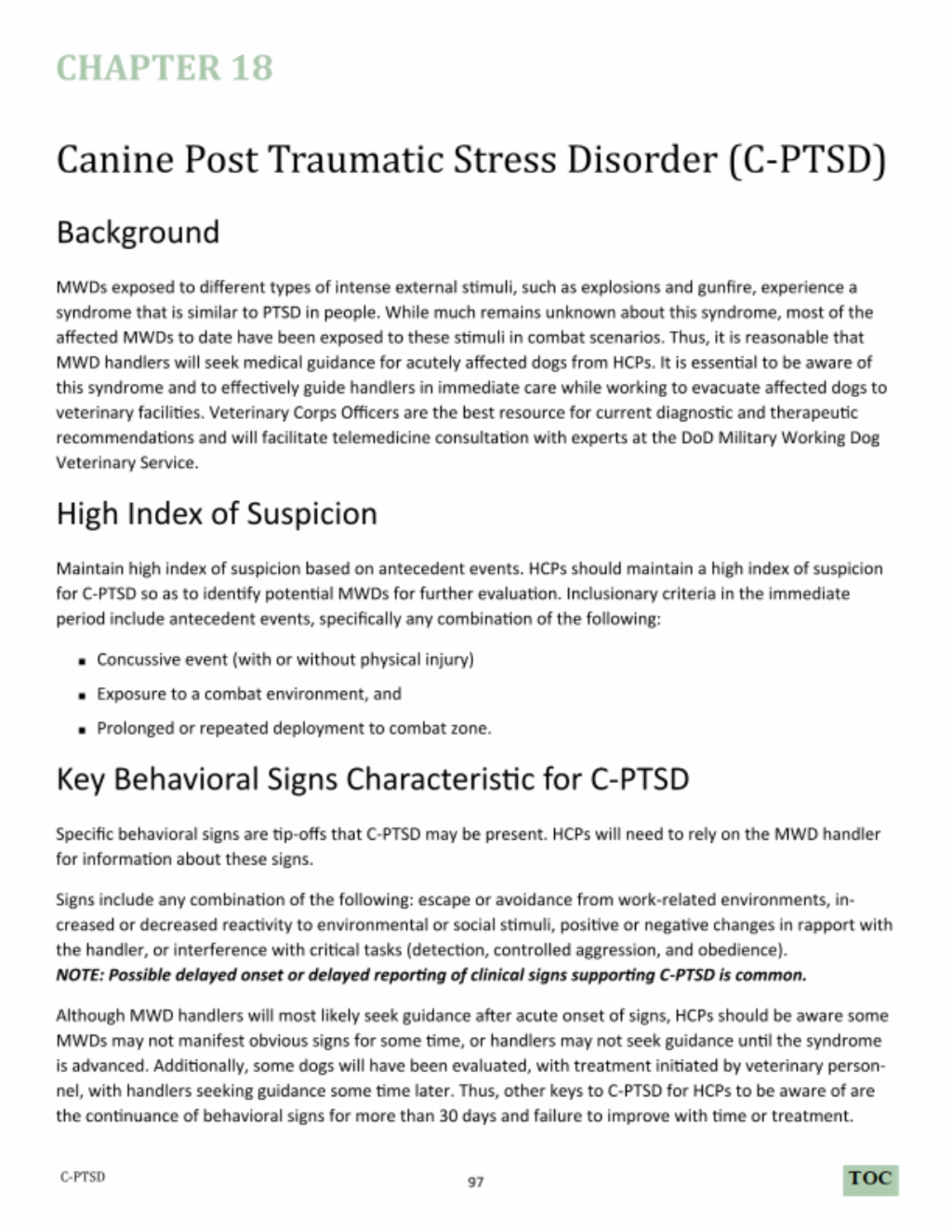
Military Working Dogs (MWDs) exposed to different types of intense external stimuli, such as explosions, gunfire, or violence, may be susceptible to developing a syndrome that is similar to Posttraumatic Stress Disorder (PTSD) in people.1,2,3,4 For more information on the background of these diagnoses and the studies and manifestation of signs in humans and animals, which is beyond the scope of this guideline, there is a chapter available in the book Mental Health and Well-Being in Animals by Frank McMillan.5
In MWDs, we refer to the syndrome as Canine Posttraumatic Stress (C-PTS), or when chronic, Canine Posttraumatic Stress Disorder (C-PTSD). While much remains unknown about these syndromes in non-human animals, most of the affected MWDs to date have been exposed to these stimuli in combat scenarios. It is essential to be aware that traumatic events, or perceived traumatic events, can alter MWD behavior and veterinary personnel need to effectively guide handlers in immediate care while working to evacuate affected dogs to a veterinary facility. Veterinary Corps Officers (VCOs) are the best resource for current diagnostic and therapeutic recommendations and will facilitate telemedicine consultation with military veterinary behavior subject-matter experts. If left unrecognized and untreated, C-PTS has the potential to develop into C-PTSD, which has a lower prognosis for successful recovery and return to work than C-PTS.
Canine Posttraumatic Stress (C-PTS) - Direct involvement or exposure to a traumatic event (or perceived traumatic event) where the canine experiences life-threatening trauma, serious injury, violence (or more). Clinical signs occur acutely or within 30 days of the event.
Canine Posttraumatic Stress Disorder (C-PTSD) - Direct involvement or exposure to a traumatic event (or perceived traumatic event) where the canine experiences life-threatening trauma, serious injury, violence (or more). Clinical signs occur or persist 30 days after the event.
Key Behavioral and Medical Signs
Canine posttraumatic stress is a diagnosis of exclusion, but an accurate history and specific behavioral and medical signs may indicate that C-PTS may be present. Providers will need to rely on the MWD handler for reporting of a traumatic event exposure and the onset of behavioral signs.
Behavioral signs will vary depending on the personality of the MWD and the perceived intensity of the traumatic event.7 They can include any combination of the following: escape or avoidance from work-related environments, increased or decreased reactivity to environmental or social stimuli, positive or negative changes in rapport with the handler, or interference with critical tasks (detection, controlled aggression, and obedience). Medical signs may include any combination of physiological responses to persistent fear, anxiety, or stress. A further description of the potential behavioral and clinical signs is provided Table 1.
NOTE: Possible delayed onset or delayed reporting of clinical signs supporting C-PTS is common, which may then fall into the category of C-PTSD.
Although MWD handlers will most likely seek guidance after acute onset of signs, providers should be aware some MWDs may not manifest obvious signs for some time, or handlers may not seek guidance until the syndrome is advanced. Additionally, some dogs will have been evaluated, and treatment initiated by veterinary personnel, from handlers seeking guidance sometime later. Thus, other keys to C-PTS for providers to be aware of are the continuance of behavioral signs for more than 30 days, resulting in the diagnosis of C-PTSD based on a failure to improve with time or treatment. The behavioral and medical signs are very similar, with the difference being persistence or progression of behavioral signs in addition to the acute versus chronic physiological stress response.

Rule Out Problems Mimicking C-PTS
Some medical problems mimic C-PTS. Providers should carefully evaluate MWDs for exclusionary criteria, such as traumatic brain injury (see K9 TBI and Acute Neurologic Injury CPG), auditory or ocular deficits, pain or discomfort, and underlying physical disease. It is important to determine if behavioral signs were occurring before the traumatic event(s) (in other words, pre-existing fear, anxiety, or stress-related behavior) to not misdiagnose C-PTS. Providers must rule-out anecdotal reports and other appropriate behavioral diagnoses, to validate a C-PTS or C-PTSD diagnosis.
Management Guidance
Listen to the MWD handler! If a handler seeks guidance for his or her working dog due to abnormal, inappropriate, or change in behavior in the first 30 days after a traumatic event or combat action, the following steps are recommended:
- Annotate a complete history of behavior prior to the event (or create a behavioral timeline if a specific event was not observed), details surrounding the event, and a chronology and progression of the MWDs behavior after the event. It is highly recommended to forward this information to the overseeing veterinary clinical specialist (AOC 64F) with request for consultation with a military veterinary behaviorist.
- Direct the handler to immediately remove the dog from the triggering situation, if not already done.
- Upon approval from the supporting veterinary officer, provide an anxiolytic drug. Examples of primary medications and adjunctive medications are provided in Table 2.
NOTE: These medications should not be stopped abruptly. If giving daily for more than two weeks, a short weaning period is indicated. Please contact a military veterinary behaviorist if you need additional guidance.

- Direct the handler to provide support for the dog with social activity and play. Provide them with references and/or examples of appropriate enrichment activities. Common examples are provided in Table 3. The key for each activity is that the MWD must positively engage in the activity and show visible signs of enjoyment and/or relaxation (based on interpretation of canine body language).
- Direct the handler to provide work therapy by performing critical tasks in a safe, quiet area, free from distress.
- Recommend to the handler and the commander that the MWD not be used in the tactical environment until the dog has been evaluated by a Veterinary Corps Officer.
- If the MWD does not respond to treatment and is unable to return to work, coordinate evacuation or redeployment for further evaluation and care, based on the tactical situation and resource availability. MWDs with C-PTS should be classified as ROUTINE for evacuation planning purposes.

Long Term Management
There is no role for providers to attempt long-term or delayed management of presumed C-PTSD in a deployed setting. Misdiagnosis and/or delay of appropriate treatment will equally jeopardize the affected MWD’s proper therapy and potential of return to duty. Affected dogs who are refractory to treatment of C-PTS should be evaluated under the supervision of Veterinary Corps Officers through consultation with a Veterinary Corps board-certified veterinary behaviorist. Ongoing research suggests a positive association with early diagnosis, +/- medication and focused desensitization/counterconditioning performed by the MWD handler in the early stages of case management. Every attempt is made to return the MWD to duty and avoid unnecessary STRATEVAC/redeployment, which can result in security and readiness issues.
Performance Improvement (PI) Monitoring
All MWDs with documented C-PTS or C-PTSD.
Return to duty without long term medication treatment.
PERFORMANCE / ADHERENCE MEASURES
- Number and percentage of patients in the population of interest (deployed MWDs) that sustained C-PTS or C-PTSD.
- Number and percentage of patients in the population of interest that required MEDEVAC/redeployment.
- Number and percentage of MWDs that required treatment with behavioral medications long-term (longer than 90 days).
- Number and percentage of MWDs that required disposition due to C-PTS or C-PTSD.
- Patient Record
- Department of Defense MWD Trauma Registry
The above constitutes the minimum criteria for PI monitoring of this K9 CPG. System reporting will be performed annually; additional PI monitoring and system reporting may be performed as needed.
The system review and data analysis will be performed by direction of the K9C4 Chair.
References
- Burghardt WF, Broach, DR. Canine Post-Traumatic Stress Disorder (C-PTSD) in military working dogs. American Veterinary Medical Association, San Antonio TX, 2016.
- Overall KL, Burghardt, WF. Report of the blue ribbon panel on post-traumatic stress disorder in military working dogs. Department of Defense Military Working Dog Veterinary Service, Lackland Air Force Base TX. 2011
- Mallonee JS, Joslin P. Traumatic stress disorder observed in an adult wild captive wolf (canis lupus). Journal of Applied Animal Welfare Science, 2004:7(2), 107-126.
- Yamamoto, Toshio. An unusual behavior and Post Traumatic Stress Disorder (PTSD)-like syndrome in dogs after the vigorous earthquake with seismic scale of 5+ degree. Journal of Veterinary Medicine 984;2003: 535-41.
- McMillan FD. Chapter 14 - Psychological trauma and posttraumatic psychopathology in animals. Mental health and well-being in animals, 2019: https://doi.org/10.1079/9781786393401.0182.
- American Psychiatric Association. Diagnostic and statistical manual of mental disorders (5th ed.). 2013: Washington DC: Author.
- Kartashova LA, Ganina KK, Karelina EA, and Tarasov SA. How to evaluate and manage stress in dogs - A guide for veterinary specialist. Applied Animal Behaviour Science, 2021:243, 1-13.
Appendix A: Class VIII Medical Materiel
Summary of the Joint Trauma System (JTS) Clinical Practice Guideline (CPG) for Canine Posttraumatic Stress (C-PTS) and Posttraumatic Stress Disorder (C-PTSD). This guideline supports the behavioral health of Military Working Dogs (MWDs) and Operational K9s in deployed environments.
- Veterinary stethoscope
- Veterinary sphygmomanometer or Doppler BP unit
- Thermometer (digital or rectal)
- Blood draw supplies (needles, syringes, vacutainers)
- CBC/Chemistry portable analyzer (e.g., i-STAT)
- Neurologic exam tools (penlight, reflex hammer)
- Otoscope/Ophthalmoscope
- Transport crate (airline- or kennel-approved) – Used for safe and secure transport of the MWD during evacuation.
- Leash and muzzle – For safe and controlled handling during movement or clinical assessment.
NOTE: See Table 2: MWD Medications and Dosages for Management of C-PTS and C-PTSD.
Primary medication options are available through the Joint Deployment Formulary (JDF). Adjunct medications (gabapentin and clonidine) are available through the JDF. The additional adjunct medications can be used if available at veterinary facilities.
Exercise
See Table 3: Activity Options for Behavioral Treatment.
- MWD behavioral history form – Used to document a complete history of behavior before and after the traumatic event.
- Telemedicine capabilities (internet, phone) – For consultations with Veterinary Corps Officers and behavior specialists.
For additional information including National Stock Number (NSN), please contact dha.ncr.med-log.list.lpr-cps@health.mil
DISCLAIMER: This is not an exhaustive list. These are items identified to be important for the care of combat casualties.
Download CPG to PDF
READ FULL PDF